
New opportunities open daily. Don't miss out!
Get alertsCaCTüS Internship 2027 in Germany: Fully Funded
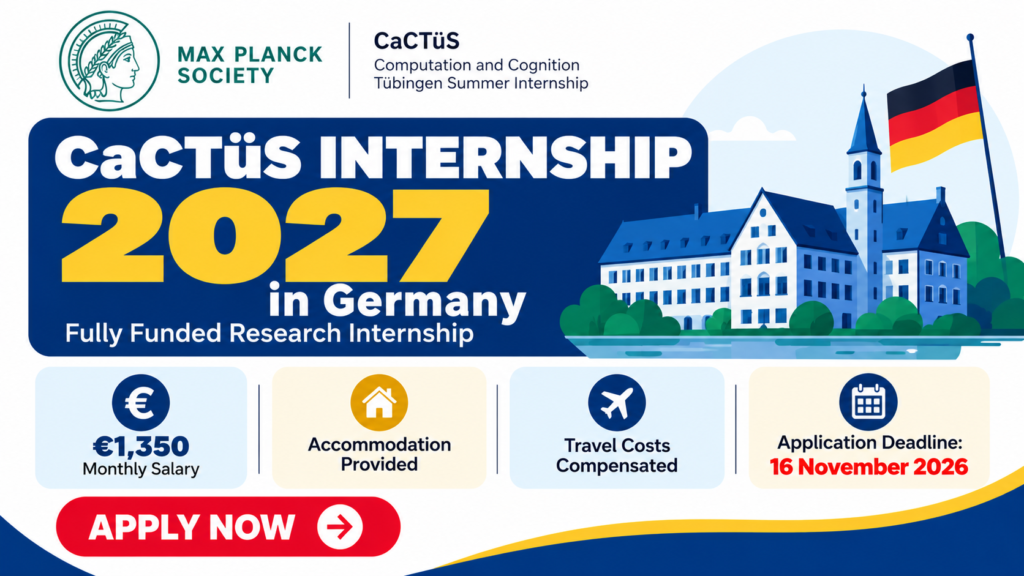
Scholarship summary
- Deadline
- Nov 16th, 2026
Application Tracker
- Application OpenAccepting applications
- Under ReviewApplications being reviewed
- Assessment PhaseCandidates being assessed
- Winners AnnouncedResults published
Scholarship Details
Introduction
Applications are open for the CaCTüS — Computation and Cognition Tübingen Summer Internship 2027, a paid research internship programme hosted by research institutions in Tübingen and Stuttgart, Germany.
The programme aims to support talented students who face personal, financial, regional or societal barriers to pursuing higher education and scientific development. It gives participants the opportunity to work on research projects under experienced scientists, gain practical research experience and connect with researchers in leading scientific institutions.
The internship focuses on research at the intersection of artificial intelligence (AI), machine learning, neuroscience, cognitive science and related fields. Students may work on projects involving computer science, mathematics, physics, engineering, psychology, behavioural science and other relevant disciplines, depending on the available research projects.

The 2027 internship runs for three months, from 1 July to 30 September 2027. Selected interns will receive a monthly salary of approximately €1,350, which the programme states is intended to cover living expenses, accommodation and health insurance. Travel costs are also compensated.
The programme particularly encourages applications from students living in low- and middle-income countries that are underrepresented in science. Previous cohorts have included students from Nigeria and other African countries.
If you are an undergraduate or master’s student interested in scientific research and have faced barriers to accessing internationally recognised research opportunities, this programme may be worth considering.
Benefits
The CaCTüS Internship offers financial support, practical research experience and professional development opportunities.
1. Monthly Salary of Approximately €1,350
Selected interns receive a monthly salary of approximately €1,350. According to the programme website, this amount is intended to cover living expenses, accommodation and health insurance during the internship.
The exact terms of payment should be confirmed in the official offer and programme documentation.
2. Accommodation Arranged by the Programme
The Internship Coordination Office arranges accommodation for selected interns because finding suitable housing can be difficult.
This support helps participants prepare for their three-month stay in Germany.
3. Travel-Cost Compensation
Interns also receive compensation for their travel costs.
However, expenses associated with visa matters—including visa application fees and trips to the embassy—cannot be reimbursed under the stated programme terms.
4. Hands-On Research Experience
Participants work on research projects under the supervision of experienced scientists.
This provides an opportunity to apply their academic knowledge to practical research questions and develop skills relevant to scientific careers.
5. Access to Leading Research Institutions
Interns will have the opportunity to work in Tübingen or Stuttgart, two locations associated with major research activities in biological sciences, artificial intelligence and related fields.
The wider research environment includes institutions and centres working in machine learning, neuroscience, cognitive science and intelligent systems.
6. Mentorship and Scientific Networking
Participants can connect with supervisors, researchers and other scientists on campus. They also receive personal and administrative support from the programme coordination team.
These connections may help interns understand research careers and build professional relationships within the scientific community.
7. Professional Development Activities
In addition to research work, the programme offers complementary activities such as:
- Soft-skills courses, including scientific presentation training.
- Application training.
- Career counselling.
- Visits to other research institutes in the region.
- Social gatherings with scientists.
- An opportunity to present research findings to the scientific community on campus at the end of the internship.
The programme’s supporting activities are made possible in part through the Hanrieder Foundation for Excellence’s Hanrieder Impact Fund.
Eligibility
The CaCTüS Internship is intended for motivated students whose access to higher education and scientific development has been constrained by personal, financial, regional or societal circumstances.
Applicants should review the following requirements before applying.
1. Academic Status
Applicants must not have started a PhD degree by the time the internship begins.
Students who have not yet completed their bachelor’s degree must have completed at least four semesters, equivalent to two years of study, before the internship starts.
Bachelor’s and master’s students with a strong interest in research are encouraged to apply, provided they meet the relevant requirements.
2. Relevant Academic Background
Applicants should have a background relevant to the research projects available. Relevant fields may include:
- Computer science.
- Mathematics.
- Physics.
- Engineering.
- Psychology.
- Cognitive science.
- Neuroscience.
- Other related disciplines relevant to the selected project.
The precise technical and academic requirements depend on the individual research project.
3. Strong Academic Record
Applicants are expected to demonstrate a strong academic record and the ability to contribute to a research project.
The general eligibility information does not specify a single minimum GPA for all applicants.
4. English-Language Proficiency
Applicants must have a good command of English because they need to communicate their motivation and participate in research activities.
The general eligibility information does not state a universal IELTS or TOEFL score requirement.
5. Demonstrated Motivation
Applicants should be able to explain their interest in science, why they want to participate in the internship and how the opportunity relates to their future academic or professional plans.
They should also explain their motivation for the research project or projects they select.
6. Barriers to Accessing Higher Education
A central part of the programme is its focus on students whose access to high-quality higher education and scientific development has been constrained.
Applicants should be prepared to explain the personal, financial, regional or societal circumstances that have made access to internationally recognised research opportunities more difficult.
7. Full Availability for the Internship
Applicants must be available for the entire 90-day internship period from 1 July to 30 September 2027.
The programme states that participants cannot extend their stay in Germany beyond 90 days because of visa regulations.
The internship must be voluntary in the academic sense: the programme cannot host students who require the internship to count for course credits as a compulsory course requirement.
8. Additional Requirement for Certain Projects
Applicants for Projects 1–4 must remain enrolled at an academic institution throughout the period from January to October 2027.
Check the specific project descriptions to determine whether this additional condition applies to your preferred project.
9. Diversity and Inclusion
The Max Planck Society welcomes qualified applicants irrespective of gender, disability, marital or parental status, racial, ethnic or social origin, colour, religion, belief or sexual orientation.
The programme explicitly encourages women to apply. Applicants with severe disabilities receive preferential consideration when their suitability, qualifications and professional performance are otherwise essentially equal.
Students living in low- and middle-income countries that are underrepresented in science are also explicitly encouraged to apply.
Deadline
The application deadline for the CaCTüS Internship 2027 is 16 November 2026.
The published programme timeline is:
| Activity | Date |
|---|---|
| Application portal opens | 21 October 2026 |
| Application deadline | 16 November 2026 |
| Interviews | January 2027 |
| Acceptance notifications | February 2027 |
| Internship begins | 1 July 2027 |
| Internship ends | 30 September 2027 |
Applicants should complete and submit their applications before the deadline. An application is not considered complete merely because information has been entered into the portal; the programme states that applicants should receive an automatic confirmation email after successful submission.
How to Apply
Applications must be submitted through the official CaCTüS online application portal. The programme does not accept applications submitted by email or through third-party application providers.
Step 1: Visit the Official Website
Visit:
Review the programme information, eligibility requirements and application instructions.
Step 2: Explore the Available Research Projects
Read the descriptions of the available research projects and identify the ones that match your academic background, skills and interests.
Project-specific requirements may differ, so do not select a project solely because its title sounds interesting. Check the required knowledge and experience carefully.
Step 3: Prepare Your Motivational Statement
The application requires a motivational statement covering the following areas:
General motivation: Explain why you want to pursue a career in science and participate in the internship.
Previous project: Describe a project you have worked on previously.
Project preferences: Explain your motivation for up to two specific research projects, ranked according to your preference, as described in the current programme instructions.
Barriers to higher education: Explain the financial, regional, personal or societal factors that have constrained your access to higher education or internationally recognised research opportunities.
Your statement should reflect your actual experience, motivation and circumstances.
Step 4: Prepare the Required Documents
The programme lists the following application documents:
- CV: Maximum two pages.
- Academic transcripts: Transcripts from all university studies.
- Degree certificates: Include these if available.
- Reference letter: One reference letter is optional.
If your university does not provide an official English translation of your transcripts, the programme asks you to provide an English translation yourself in the first instance.
The official website also provides an application guide and an example CV to help applicants prepare their submissions.
Step 5: Complete the Online Application
Submit your application through the official application portal.
Do not email your application directly to supervisors or laboratories. The programme specifically asks applicants not to contact supervisors or mentors to promote their applications.
Once submitted, the application will be reviewed through the programme’s established selection process.
Step 6: Confirm Successful Submission
After completing your application, look for the automatic confirmation email from the application portal.
If you do not receive the confirmation, the programme advises that your application may be incomplete and must be fully submitted before the deadline to be considered.
Step 7: Prepare for the Selection Process
The selection process has three main stages:
- Pre-selection: The Internship Office screens applications before forwarding them to relevant project laboratories.
- Interviews: Shortlisted applicants are invited to virtual interviews involving personal and technical questions.
- Acceptance: Successful applicants receive an official CaCTüS Internship offer letter by email.
Important Note on Using AI in the Application
The programme permits AI tools to help improve the clarity, grammar, style and overall quality of written language. However, AI must not be used to generate ideas, develop concepts or produce original intellectual content.
Your ideas, analyses and substantive contributions must originate from you. Make sure your application honestly reflects your own thinking and experience.
Visa Information
Applicants who require a visa to participate in the internship should begin checking the relevant requirements early.
The programme states that it will support accepted students with the visa process as much as possible. However, it cannot guarantee that visas will be issued in time.
If visa processing is delayed, the programme may try to find an individual solution, such as deferring the internship position by one year. This is not guaranteed.
Remember that visa application fees and embassy-trip expenses cannot be reimbursed under the stated programme terms.
Conclusion
The CaCTüS Internship 2027 offers an opportunity for eligible bachelor’s and master’s students to gain three months of paid research experience in Germany.
Participants receive an approximate monthly salary of €1,350, accommodation arranged by the programme, health insurance and travel-cost compensation. They also benefit from supervised research, professional development activities, career counselling and opportunities to connect with scientists.
The programme particularly welcomes students whose access to higher education and scientific development has been constrained, including qualified applicants from underrepresented low- and middle-income countries.
If your academic background matches an available project and you can explain your motivation and the barriers you have faced, review the requirements and submit your application before 16 November 2026.
Application Link
Application deadline: 16 November 2026.
Internship location: Tübingen or Stuttgart, Germany.
Internship duration: 1 July–30 September 2027.
Monthly salary: Approximately €1,350, with accommodation, health insurance and travel-cost compensation as described by the programme.
Deadline: Nov 16th, 2026
Join the Icanstudent Community
Get scholarships, tips and updates wherever you are.
Explore More
More scholarships you might be interested in.
Introduction Applications are open for the Learning Planet Youth Design Challenge (LPYDC) 2026–2027, an international initiative organised by the Learning Planet Institute…
Introduction Applications are open for the Medtronic Spark Scholarship 2027, an educational funding programme administered by the Institute of International Education (IIE)…
Introduction Applications are being reported for the Senator Abiola Ajimobi Foundation (SAAF) Educational Grant 2026, an educational financial support opportunity intended to…
Introduction Carleton University in Ottawa, Canada, offers a range of scholarships, bursaries and other financial assistance opportunities to help undergraduate students pay…
Want to see more?
There's more to discover. Find scholarships, internships and opportunities that match your interests.
Explore MoreAdd Icanstudent to your home screen
Open Icanstudent in one tap, like an app. Never miss a new scholarship.